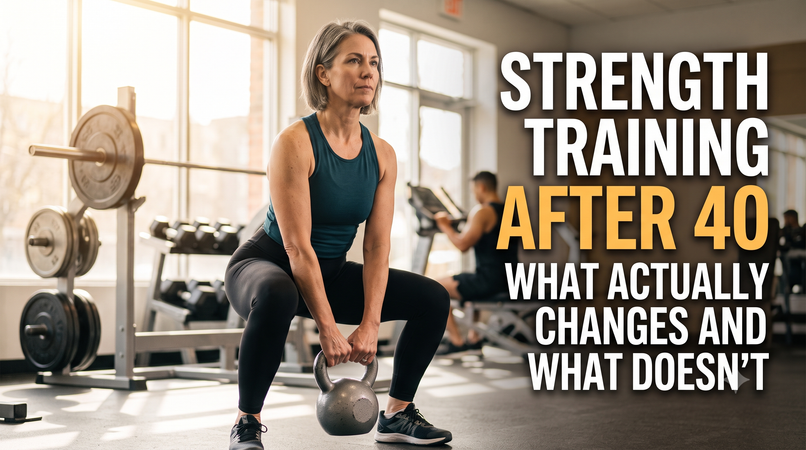
Turning 40 doesn’t mean your training has to get smaller — it means it has to get smarter. The body’s recovery capacity, joint tolerance, and hormonal environment shift gradually starting in your late 30s, but very little of this makes serious strength training unsafe or ineffective. What it does mean is that the margin for sloppy programming shrinks. This guide covers what genuinely changes with age, what’s often misunderstood, and how to train in a way that builds strength for decades rather than just the next few months.

The Real Physiological Shifts
Muscle Mass and Sarcopenia
Starting around age 30, adults who do nothing to counteract it can lose roughly 3–8% of muscle mass per decade, a process called sarcopenia. This isn’t inevitable — it’s largely a consequence of reduced activity, not age itself. Resistance training is the single most effective intervention for slowing or reversing this loss, and the response to training remains strong well into older age.
Recovery Time
Recovery between hard sessions tends to lengthen slightly with age, partly due to changes in sleep architecture and partly due to a slower inflammatory response. This doesn’t mean less total training — it usually means spacing high-intensity sessions a bit further apart and paying closer attention to sleep and protein intake.
Joint and Connective Tissue Tolerance
Tendons and ligaments adapt more slowly than muscle tissue, and previous injuries accumulate over decades. This is why warm-ups, gradual load progression, and technique quality matter more at 45 than at 22 — not because the body is fragile, but because the cost of skipping these steps compounds over a longer training history.
Hormonal Changes
Testosterone in men and estrogen in women both decline with age, affecting muscle protein synthesis and bone density, particularly for women after menopause. Strength training directly counteracts much of this impact — it’s one of the few interventions shown to meaningfully preserve bone density in postmenopausal women.
What Doesn’t Change
- The ability to get stronger. Numerous studies show adults in their 60s, 70s, and beyond continue to gain significant strength from progressive resistance training — the underlying adaptation mechanism doesn’t disappear with age.
- The need for progressive overload. Muscles and bones still need increasing demands over time to keep adapting; lifting the same light weights indefinitely produces diminishing returns at any age.
- The value of compound movements. Squats, hinges, presses, and pulls remain the most efficient way to build functional strength, provided they’re loaded appropriately for the individual’s joint history.
Programming Principles for 40+
Prioritize Technique Over Ego Lifting
A slightly lighter weight performed with full control and proper range of motion builds more usable strength — and causes far fewer injuries — than a heavier weight moved sloppily. This is true at any age but becomes more consequential as recovery slows.
Build in a Real Warm-Up
A 5–10 minute warm-up that raises core temperature and rehearses the movement pattern at low intensity reduces injury risk substantially. This might mean a lighter set of the same exercise before working weight, not just general cardio.
Train Strength 2–4 Times Per Week
This range allows enough stimulus for adaptation while leaving room for recovery. Full-body sessions two to three times a week work well for most people; four sessions with an upper/lower split suits those with more training experience.
Don’t Neglect Mobility Work
Hip, shoulder, and thoracic spine mobility often decline through repetitive daily postures — sitting, driving, screen use — more than through age itself. Ten minutes of targeted mobility work a few times a week keeps the joints capable of supporting heavier lifts.
Watch Protein Intake Closely
Because muscle protein synthesis becomes slightly less efficient with age, adults over 40 generally benefit from higher relative protein intake than younger lifters to achieve the same muscle-building response. Distributing protein across three to four meals, rather than concentrating it in one, appears to support this better.
A Sample Weekly Framework
- Day 1: Full-body strength (squat or hinge pattern, push, pull, core)
- Day 2: Mobility and light cardio
- Day 3: Full-body strength (different movement variations)
- Day 4: Rest or active recovery (walking, swimming, easy cycling)
- Day 5: Full-body strength or upper/lower split
- Weekend: One day of movement you enjoy, one full rest day
This framework leaves room to scale intensity up or down week to week, which matters more than following any fixed program rigidly.
Common Mistakes to Avoid
- Stopping heavy lifting “to be safe.” Switching entirely to light weights and high reps out of caution often accelerates strength loss rather than preventing injury. The evidence supports continued heavy, progressive training with good form.
- Skipping warm-ups to save time. This is one of the most common causes of avoidable injury in older lifters.
- Ignoring sleep. Sleep is when much of the recovery and adaptation from training actually occurs; under-recovering from poor sleep undermines even a well-designed program.
- Comparing current numbers to your 20s. Strength can still improve significantly after 40, but the trajectory and starting point are different — chasing old personal records at the expense of technique is a common source of injury.
The Bottom Line
Strength training after 40 isn’t about scaling back out of fear — it’s about training with more precision. The body still responds powerfully to progressive resistance work at any age; what changes is the importance of warming up properly, recovering deliberately, and prioritizing movement quality over raw numbers. Done well, strength training in your 40s, 50s, and beyond can build a stronger, more resilient body than most people had in their 20s.